
Our impact
Work that leaves something behind.
Recognition from national institutions, and a wearable built by our own members for the hands that keep Azerbaijani carpet weaving alive.
Project · Olympic Inclusion Lab
Sport where every young person gets a place on the team.
The Olympic Inclusion Lab is Azerbaijan’s National Inclusive Sports Innovation Initiative. Youth Collective contributed to its development: a model where children with intellectual and developmental disabilities and neurotypical young athletes participate, communicate, learn, and grow together through sport — and where young people themselves serve as leaders, Inclusion Ambassadors, peer mentors, researchers, and advocates.
A structured model
Connecting young athletes, families, coaches, educators, researchers, and youth leaders into one working structure rather than a one-off event.
A scalable ecosystem
The letter credits the contribution with building toward a scalable ecosystem for inclusive sport in Azerbaijan, designed to extend beyond a single initiative.
Olympic values, applied
Strengthening a culture of equal opportunity, respect, friendship, teamwork, fair play, and solidarity — connected to education, innovation, and community engagement.
Recognition
National Olympic Committee of Azerbaijan
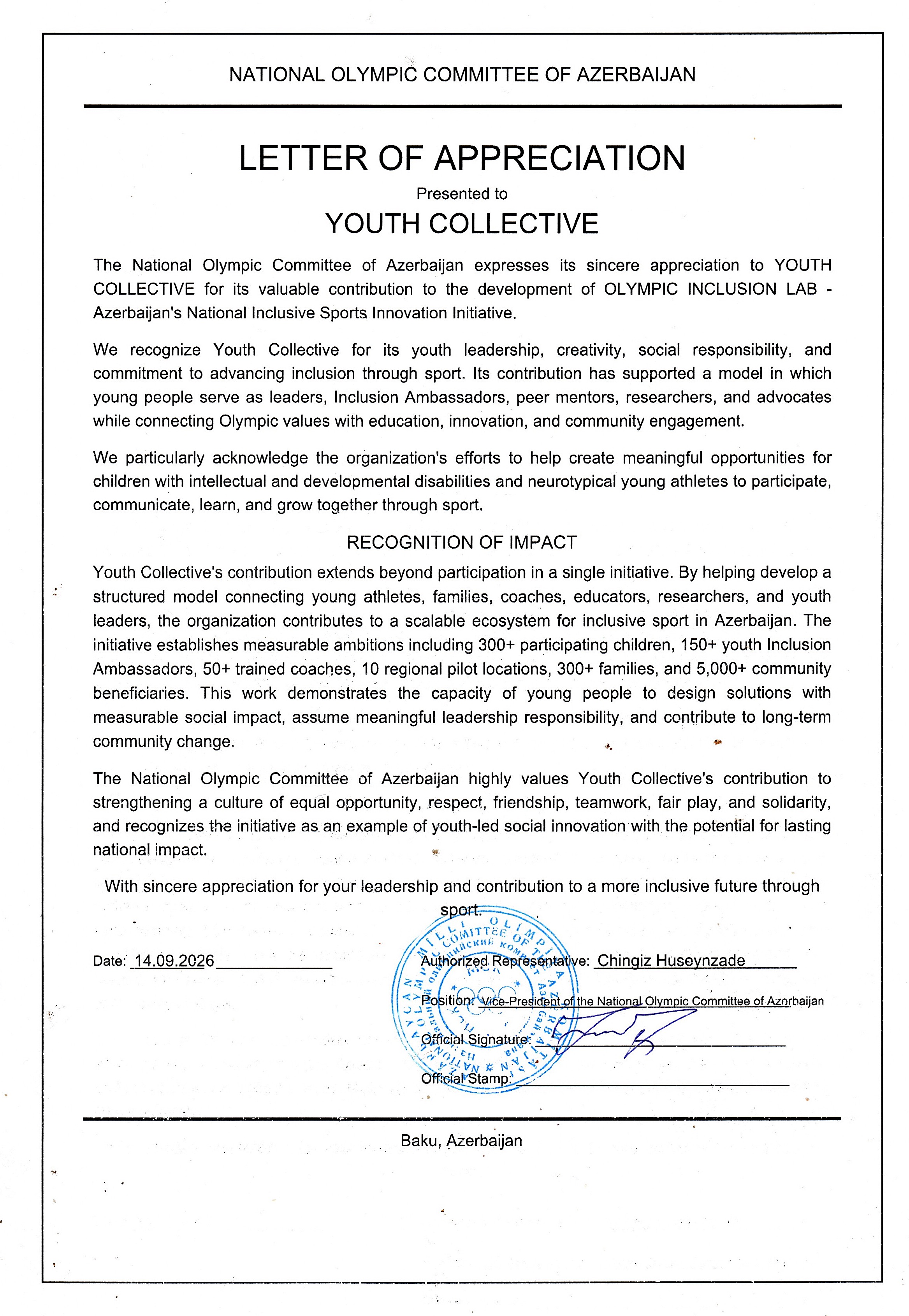
“The National Olympic Committee of Azerbaijan expresses its sincere appreciation to YOUTH COLLECTIVE for its valuable contribution to the development of OLYMPIC INCLUSION LAB – Azerbaijan’s National Inclusive Sports Innovation Initiative.”
The letter recognises Youth Collective for youth leadership, creativity, social responsibility, and commitment to advancing inclusion through sport, and acknowledges our efforts to help create meaningful opportunities for children with intellectual and developmental disabilities and neurotypical young athletes to participate, communicate, learn, and grow together through sport.
It closes by recognising the initiative as “an example of youth-led social innovation with the potential for lasting national impact.”
The Olympic Inclusion Lab sets out, in the words of the letter, “measurable ambitions” — targets the initiative is working toward, not results already achieved:
- 300+participating children
- 150+youth Inclusion Ambassadors
- 50+trained coaches
- 10regional pilot locations
- 300+families
- 5,000+community beneficiaries
Project · COP29
Youth as Catalysts for Climate Action.
A youth-led environmental initiative presented on 20 November 2024 at the Children and Youth Pavilion during COP29 in Baku. The United Nations Population Fund in Azerbaijan recognised Youth Collective for its contribution in a formal Letter of Appreciation.
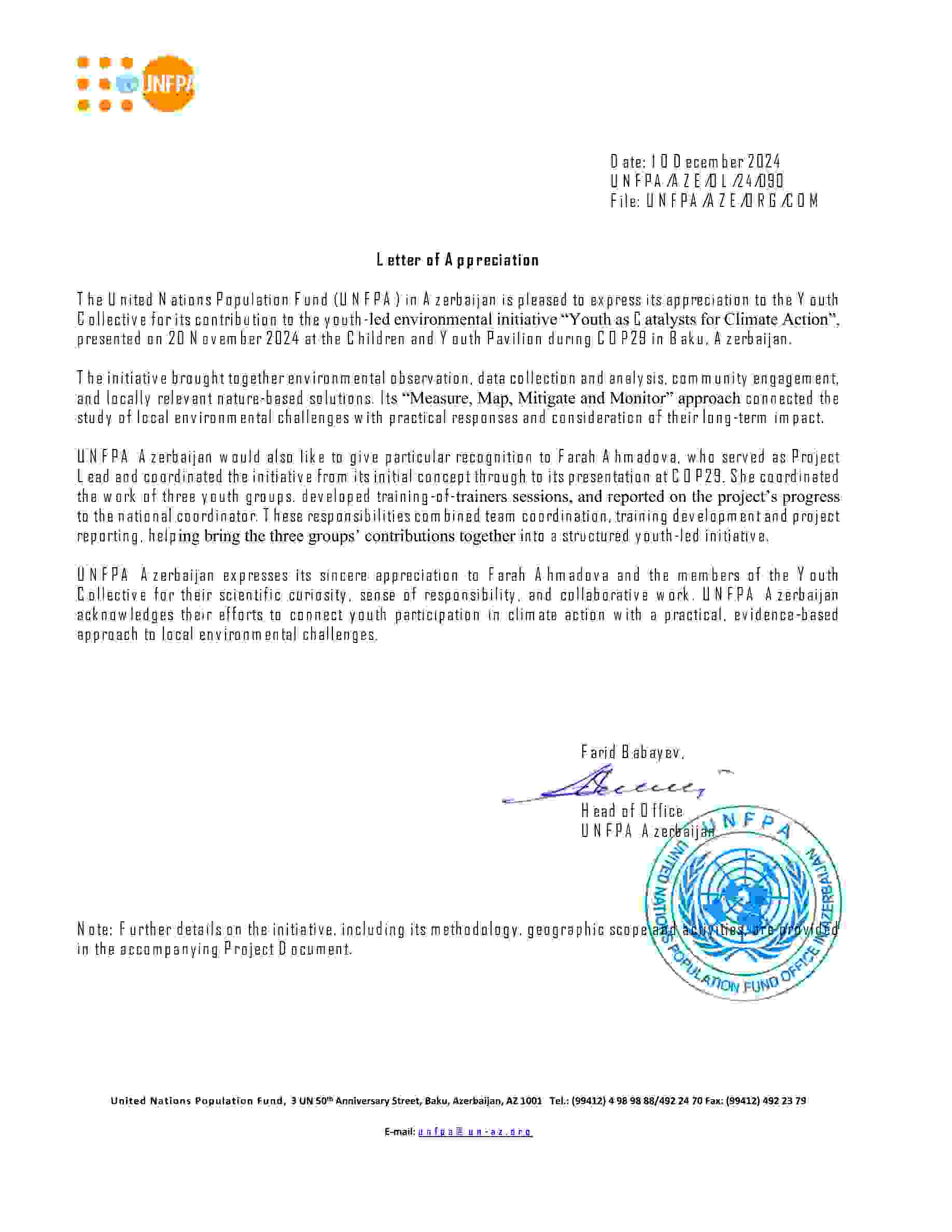
“The United Nations Population Fund (UNFPA) in Azerbaijan is pleased to express its appreciation to the Youth Collective for its contribution to the youth-led environmental initiative ‘Youth as Catalysts for Climate Action’ presented on 20 November 2024 at the Children and Youth Pavilion during COP29 in Baku, Azerbaijan.”
The letter describes an initiative that brought together environmental observation, data collection and analysis, community engagement, and locally relevant nature-based solutions, with a “Measure, Map, Mitigate and Monitor” approach connecting the study of local environmental challenges to practical responses and their long-term impact.
It closes by appreciating the members of Youth Collective for their “scientific curiosity, sense of responsibility, and collaborative work,” acknowledging their efforts to connect youth participation in climate action with a practical, evidence-based approach to local environmental challenges.
What the initiative did
Environmental observation, data collection and analysis, community engagement, and locally relevant nature-based solutions — studied together rather than in isolation.
Measure, Map, Mitigate, Monitor
The four-step approach named in the letter, connecting local environmental challenges to practical responses and consideration of their long-term impact.
Three youth groups
Separate groups whose contributions were brought together into one structured youth-led initiative, supported by training-of-trainers sessions and progress reporting.
Particular recognition
Farah Ahmadova — Project Lead
UNFPA Azerbaijan gave her particular recognition for coordinating the initiative from its initial concept through to its presentation at COP29. Her responsibilities, as set out in the letter:
- Coordinated the work of the three youth groups
- Developed training-of-trainers sessions
- Reported on the project’s progress to the national coordinator
Together these combined team coordination, training development and project reporting — helping bring the three groups’ contributions together into a structured youth-led initiative.
Project · ReHand Loom
Supporting the hands that preserve Azerbaijan’s carpet traditions.
A carpet takes months, and the weaver’s hands carry every one of them — the same grip, the same knot, repeated until the pattern is finished. ReHand Loom pairs a wearable device with a digital platform to study hand and wrist workload at the loom, and shares that information with specialists who give each artisan individualized advice on working practices and load distribution.
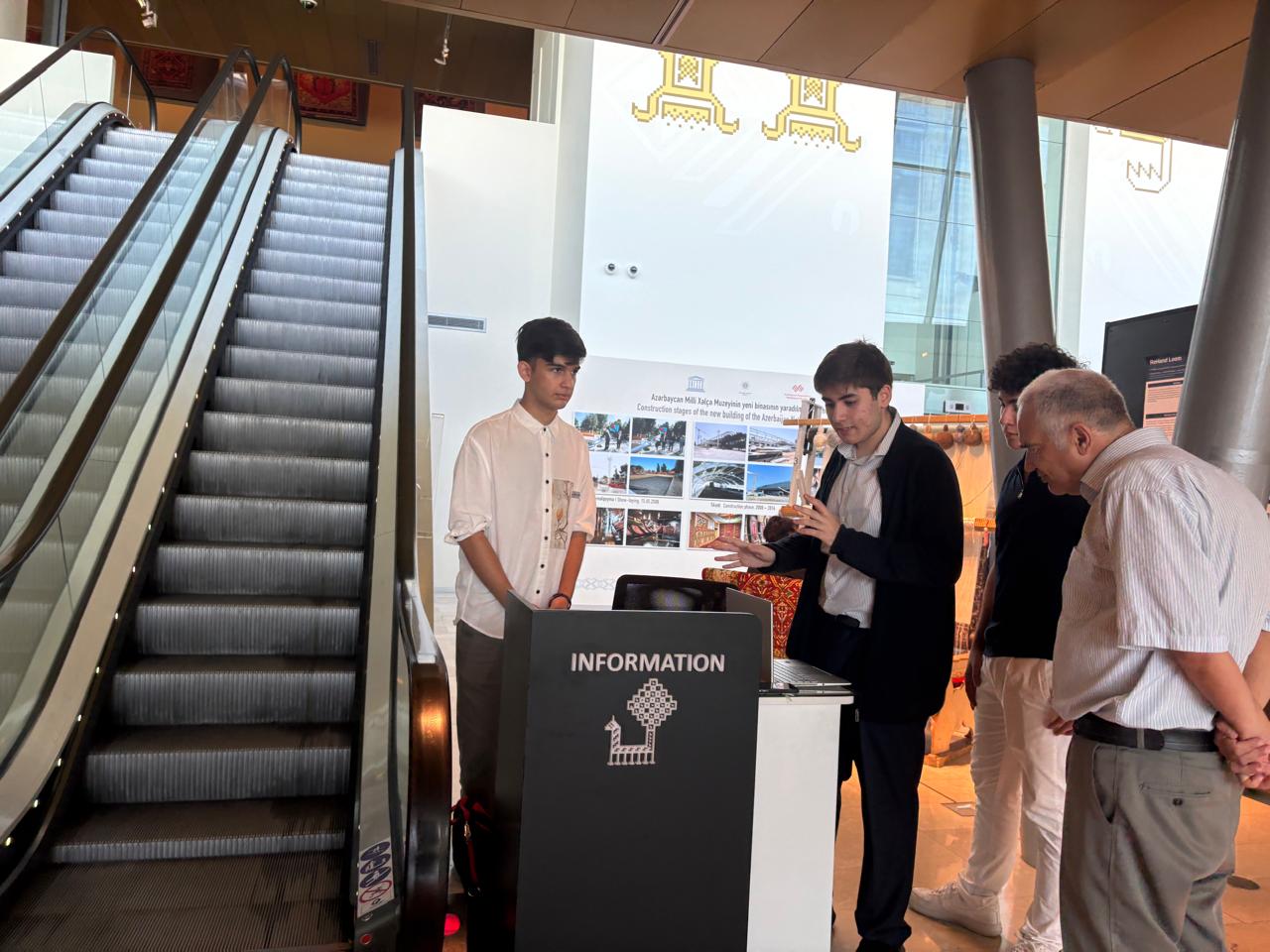
Created and presented by Mikayil Ahmadbayli, Youssef El Haroun and Ilyas Taghiyev — equal collaborators at every stage, from build to presentation.
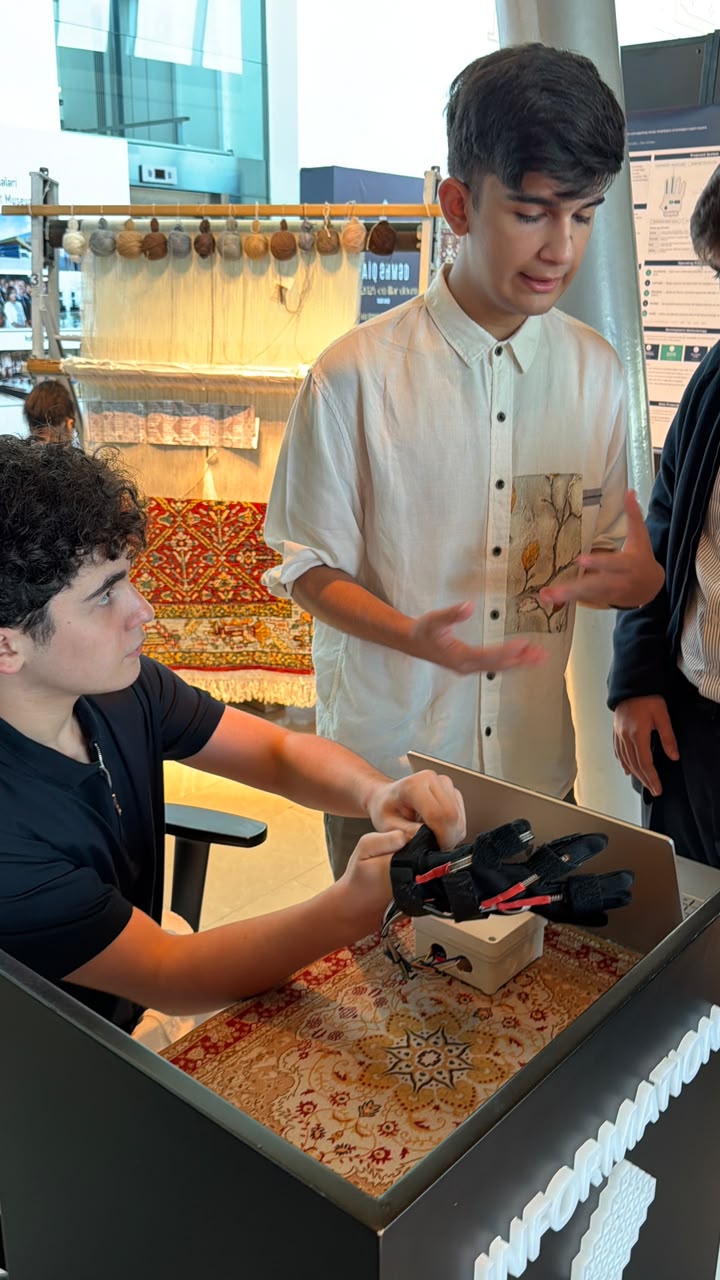
A wearable, and a platform to make sense of it.
The wearable is deliberately low-cost — off-the-shelf sensors, a small controller, and a housing the team assembled themselves — so it can be reproduced rather than locked behind a price tag. It records how the hand and wrist are actually loaded during a working session.
The digital platform turns those readings into a report a specialist can review, and the specialist responds with advice tailored to that artisan’s own way of working. The device measures and reports; the specialist advises. It is a support tool and does not replace professional care.
-
Flex
Finger bend
Tracks how far each finger curls through the knotting motion.
-
Pressure
Grip force
Measures how hard the hand is gripping, and for how long.
-
Motion
Hand movement
Captures the repetition and rhythm of the weaving gesture.
Reach so far
Outreach, support and training outcomes reported by the project team. They describe participation, specialist review and training activity — not clinically proven recovery.
Carried on locally
The sessions kept running after the team went home.
Eight of the sessions were delivered by trained local partners on their own. Cultural staff and regional coordinators ran them using the team’s protocol, training materials and digital reporting template — the same method, in the hands of the people already working closest to the weavers.
- ProtocolThe session structure, step by step.
- Training materialsWhat partners need to lead it themselves.
- Reporting templateDigital forms that keep records consistent.
Presented at
Azerbaijan National Carpet Museum
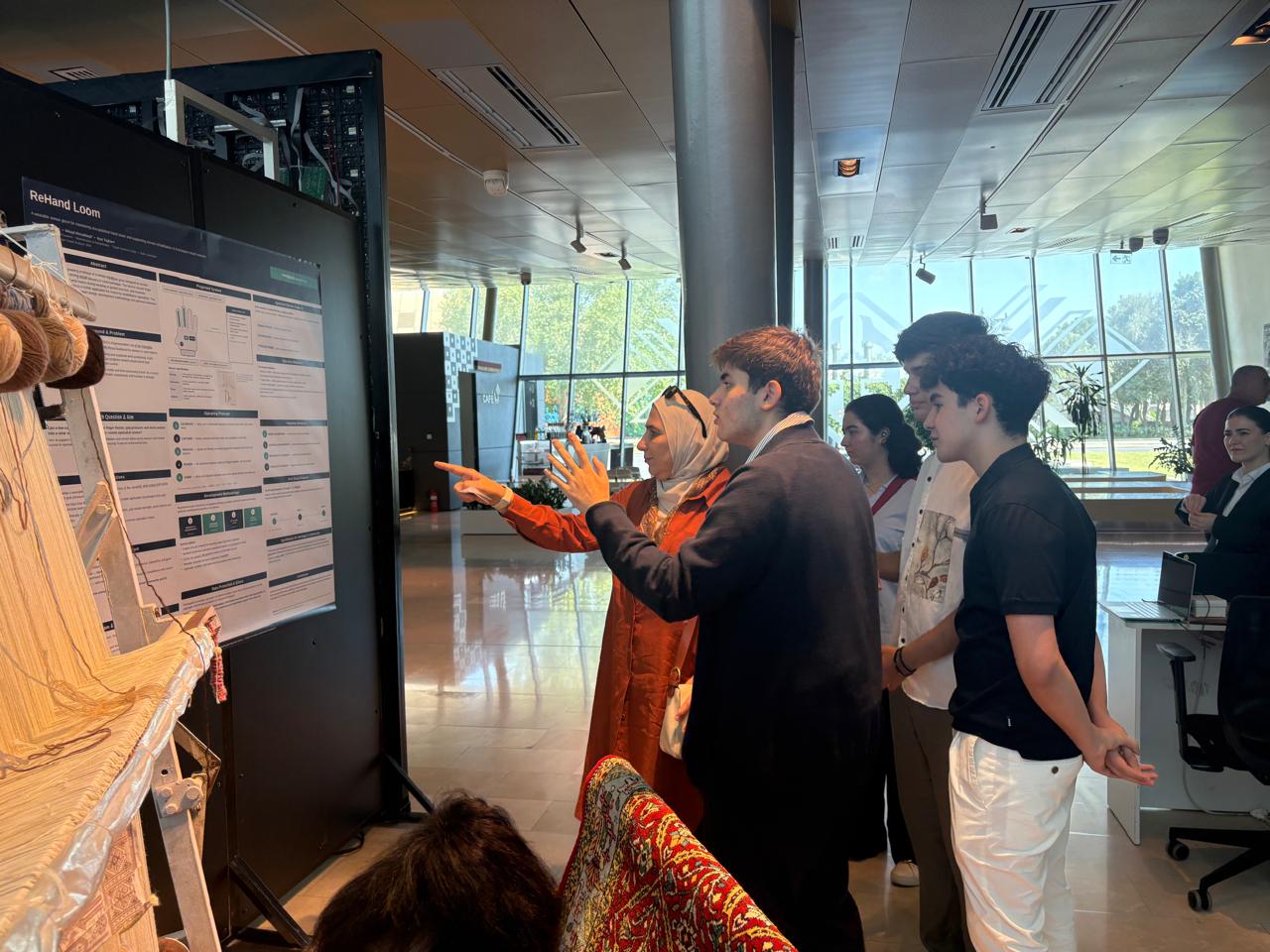
Mikayil, Youssef and Ilyas presented ReHand Loom together at the museum in Baku, showing the wearable and the research poster to visitors, weavers and museum staff beside a working loom.
Recognition
Ministry of Culture
The Ministry of Culture of the Republic of Azerbaijan expressed its appreciation for the initiative.